Note
Go to the end to download the full example code.
Toeplitz-Embedded Self-Adjoint A^H A for SparseFFT Gadgets#
Iterative reconstructions (CG, FISTA) repeatedly evaluate the normal
operator A^H A. PyGROG ships a Toeplitz-embedded short-circuit:
op.normal(image) builds a small PSF once and replaces every
forward+adjoint NUFFT pair by a pad → FFT → multiply → IFFT → crop
sequence.
The example has two parts:
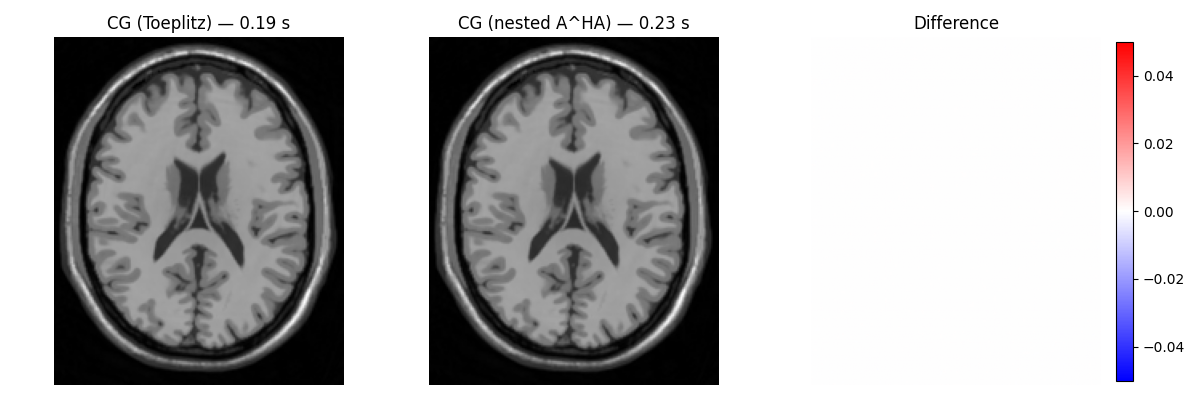
End-to-end pipeline — a real BrainWeb / spiral / GROG / SparseFFT acquisition, a CG reconstruction using
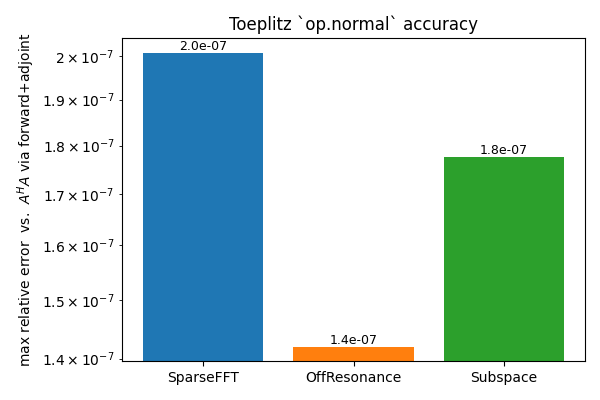
op.normal, and a runtime comparison against the nestedforward(adjoint(.))baseline.Accuracy panel for the gadgets — small synthetic problems verifying that the Toeplitz versions of ORC and subspace operators match the nested baseline to numerical noise.
The Toeplitz path is the default on CPU and is opt-in on CUDA via
toeplitz=True.
import time
import types

import matplotlib.pyplot as plt
import numpy as np
import torch

from brainweb_dl import get_mri

from mrinufft import get_operator, initialize_2D_spiral
from mrinufft.density import voronoi

from pygrog.calib import GrogInterpolator
from pygrog.gadgets import SubspaceGadget
from pygrog.gadgets._off_resonance import OffResonanceSparseFFT
from pygrog.operator import SparseFFT
Part 1: End-to-End SparseFFT with CG Reconstruction#
Demonstrate the Toeplitz-embedded normal() operator for fast
\(A^H A\) matrix-vector products, then use it in a CG solver.
image = np.flip(get_mri(0, "T1"), axis=(0, 1, 2))[90].astype(np.float32)
/home/docs/checkouts/readthedocs.org/user_builds/pygrog/envs/latest/lib/python3.12/site-packages/mrinufft/_utils.py:67: UserWarning: Samples will be rescaled to [-pi, pi), assuming they were in [-0.5, 0.5)
  warnings.warn(
Benchmark: Normal Operator Performance#
Compare the speed of op.normal(x) with Toeplitz acceleration
vs. the nested A^H A approach.
# A^H A timing on a random image
torch.manual_seed(0)
x = torch.randn(*shape, dtype=torch.complex64)
t_toep, y_toep = _bench(op_t.normal, x)
t_nest, y_nest = _bench(op_n.normal, x)
err_sparse = _rel_err(y_toep, y_nest)

print(
    f"SparseFFT  Toeplitz {t_toep * 1e3:7.2f} ms  |  nested {t_nest * 1e3:7.2f} ms"
    f"  | speed-up x{t_nest / t_toep:5.2f}  | rel-err {err_sparse:.2e}"
)
SparseFFT Toeplitz 14.95 ms | nested 17.98 ms | speed-up x 1.20 | rel-err 2.01e-07
CG Reconstruction Using Toeplitz Normal Operator#
t0 = time.perf_counter()
recon_toep = cg(op_t.normal, b, n_iter=12)
t_cg_toep = time.perf_counter() - t0
t0 = time.perf_counter()
recon_nest = cg(op_n.normal, b, n_iter=12)
t_cg_nest = time.perf_counter() - t0

print(
    f"CG (12 iter):  Toeplitz {t_cg_toep:.2f} s  |  nested {t_cg_nest:.2f} s"
    f"  | speed-up x{t_cg_nest / t_cg_toep:.2f}"
)
CG (12 iter): Toeplitz 0.19 s | nested 0.23 s | speed-up x1.22
recon_t_np = np.abs(recon_toep.detach().cpu().numpy())
Part 2 — accuracy of the gadget Toeplitz operators#
Small random problems where OffResonanceSparseFFT and
SubspaceGadget are used directly to verify that
op.normal gives the same result for
toeplitz=True and toeplitz=False.
# ---- ORC ----------------------------------------------------------------
grid = (32, 32)
n_samples = 800
L = 4
op_b_t = _make_small_sparse_fft(grid, n_samples, 4, toeplitz=True, seed=0)
op_b_n = _make_small_sparse_fft(grid, n_samples, 4, toeplitz=False, seed=0)
rng = np.random.default_rng(11)
B = (
    rng.standard_normal((n_samples, L)) + 1j * rng.standard_normal((n_samples, L))
).astype(np.complex64)
C = (rng.standard_normal((L, *grid)) + 1j * rng.standard_normal((L, *grid))).astype(
    np.complex64
)
orc_t = OffResonanceSparseFFT(op_b_t, B, C, toeplitz=True)
orc_n = OffResonanceSparseFFT(op_b_n, B, C, toeplitz=False)
x_orc = torch.randn(*grid, dtype=torch.complex64)
t_toep, y_toep = _bench(orc_t.normal, x_orc, n_iter=5)
t_nest, y_nest = _bench(orc_n.normal, x_orc, n_iter=5)
err_orc = _rel_err(y_toep, y_nest)
print(
    f"ORC (L={L})   Toeplitz {t_toep * 1e3:7.2f} ms  |  nested {t_nest * 1e3:7.2f} ms"
    f"  | speed-up x{t_nest / t_toep:5.2f}  | rel-err {err_orc:.2e}"
)

# ---- Subspace -----------------------------------------------------------
T = 12
K = 4
n_pts = 60
n_samples_sub = T * n_pts
rng = np.random.default_rng(13)
indices = rng.integers(0, int(np.prod(grid)), n_samples_sub).astype(np.int64)
weights = rng.random(n_samples_sub).astype(np.float32) + 0.1
smaps_sub = (
    rng.standard_normal((4, *grid)) + 1j * rng.standard_normal((4, *grid))
).astype(np.complex64) * 0.5
indices_t = torch.as_tensor(indices)
weights_t = torch.as_tensor(weights)
sort_perm = torch.argsort(indices_t)
inv_perm = torch.empty_like(sort_perm)
inv_perm[sort_perm] = torch.arange(n_samples_sub)
plan = types.SimpleNamespace(
    grid_shape=grid,
    image_shape=grid,
    grid_size=int(np.prod(grid)),
    indices=indices_t[sort_perm],
    sqrt_weights=weights_t.sqrt()[sort_perm],
    sort_perm=sort_perm,
    inv_perm=inv_perm,
    natural_shape=(T, n_pts),
    n_samples=n_samples_sub,
)
base_sub_t = SparseFFT(plan=plan, smaps=smaps_sub, toeplitz=True)
base_sub_n = SparseFFT(plan=plan, smaps=smaps_sub, toeplitz=False)
basis = (rng.standard_normal((K, T)) + 1j * rng.standard_normal((K, T))).astype(
    np.complex64
)
sub_t = SubspaceGadget(base_sub_t, basis, encoding_axis=-2)
sub_n = SubspaceGadget(base_sub_n, basis, encoding_axis=-2)
x_sub = torch.randn(K, *grid, dtype=torch.complex64)
t_toep, y_toep = _bench(sub_t.normal, x_sub, n_iter=5)
t_nest, y_nest = _bench(sub_n.normal, x_sub, n_iter=5)
err_sub = _rel_err(y_toep, y_nest)
print(
    f"Subspace (K={K}) Toeplitz {t_toep * 1e3:7.2f} ms  |  nested {t_nest * 1e3:7.2f} ms"
    f"  | speed-up x{t_nest / t_toep:5.2f}  | rel-err {err_sub:.2e}"
)
ORC (L=4)   Toeplitz    0.57 ms  |  nested    0.95 ms  | speed-up x 1.66  | rel-err 1.42e-07
Subspace (K=4) Toeplitz    0.55 ms  |  nested    4.60 ms  | speed-up x 8.44  | rel-err 1.78e-07
Accuracy summary#
labels = ["SparseFFT", "OffResonance", "Subspace"]
errs = [err_sparse, err_orc, err_sub]
fig, ax = plt.subplots(figsize=(6, 4))
Total running time of the script: (0 minutes 2.162 seconds)